
Frequency
How often should office restrooms be cleaned?
Every visit, without exception — and if that is not enough, the answer is more visits rather than a longer restroom scope on the same one.
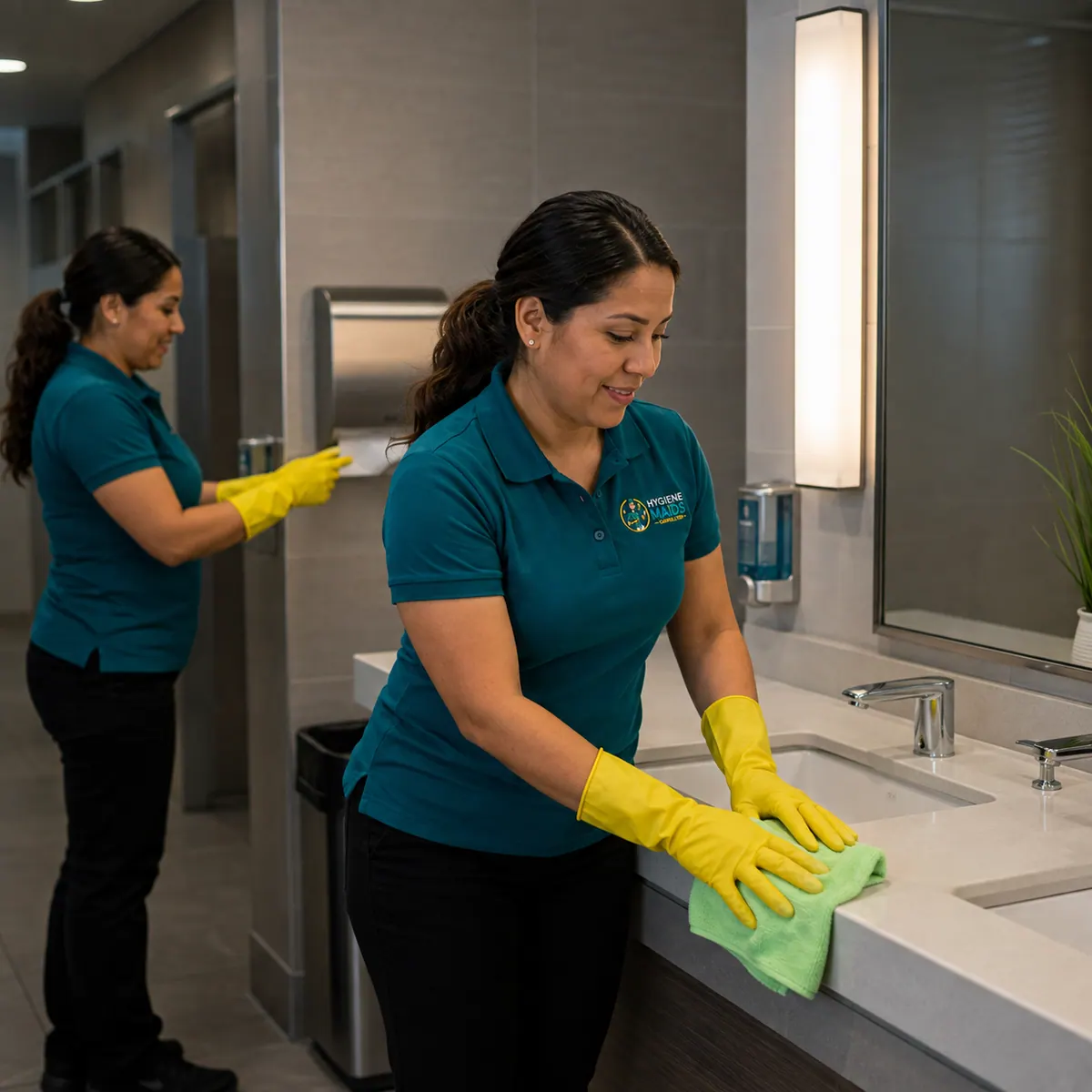
Restrooms set the ceiling on everything else
In almost every building we scope, the restroom requirement determines the cleaning frequency, and every other area is then cleaned at whatever frequency that produces.
That sounds backwards but it is the correct order. Restrooms are the only area where a single day of neglect is genuinely unacceptable rather than merely untidy, and they are the area that generates complaints out of all proportion to their floor area.
So the sensible sequence is: work out how often the restrooms need attention, set the schedule to that, then distribute everything else across the visits that produces. A building whose restrooms need daily attention gets a daily schedule, and its meeting rooms benefit from that whether they needed it or not.
It also means the answer to "how often should restrooms be cleaned" is really two answers: they are cleaned on every visit that happens, and the number of visits is set by the restrooms themselves.
Working out how many visits the restrooms need
Fixture count against daily users is the practical measure. Public-facing buildings sit a tier higher than these.
| Users per fixture per day | Visits needed | Typical building |
|---|---|---|
| Up to about 10 | Once or twice a week | Small professional office, few visitors. |
| About 10 to 20 | Three nights a week | Mid-sized office with adequate fixtures. |
| About 20 to 40 | Five nights a week | Busy office, or one with too few fixtures for its headcount. |
| Over 40 | Daily plus a day check | High-density office, or a building with public footfall. |
| Public access, any density | Daily, often multiple times | Retail, restaurant, clinic, convenience store. |
Count fixtures, not restrooms. Two single-occupancy restrooms serving thirty people is a very different situation from one restroom with four stalls serving the same thirty.
The consumables problem
Most restroom complaints in an office are not about cleanliness. They are about running out of something.
Paper and soap deplete on a schedule set by use, and that schedule has nothing to do with when a cleaning contractor visits. A restroom cleaned to a high standard on Monday night that is out of paper towels by Wednesday afternoon will still generate complaints, and those complaints will be about the cleaning.
There are three fixes, in order of how well they work. First, larger-capacity dispensers, which is a one-off cost that permanently reduces the problem. Second, restocking to full capacity on every visit rather than topping up to a level. Third, more frequent visits, which is the expensive answer and should be the last resort for a consumables problem specifically.
Whichever you choose, decide explicitly who is responsible for stock levels and put it in the scope. Ambiguity here is the single most common source of friction on an otherwise fine contract.
A quick diagnostic
When restroom complaints come in, ask what the complaint actually is. "It was dirty" points at frequency or at scope quality. "There was no paper" points at consumables and dispenser capacity. "It smelled" usually points at floor and fixture-base cleaning, or at drains and ventilation rather than at the cleaning at all. The three have completely different fixes, and treating all of them as "clean more often" is expensive.
What every restroom visit should include
No tiering here — all of it, every time.
Fixtures
- Toilets and urinals cleaned and disinfected inside and out
- Bases and behind fixtures, not just the visible faces
- Flush handles and sensors
- Sinks, taps and counters
- Mirrors cleaned streak-free
Surfaces and touchpoints
- Partition doors, latches and handles disinfected
- Entry door handles and push plates
- Dispensers wiped
- Baby-change surfaces disinfected where present
- Grab rails and accessibility fittings
Consumables and waste
- Toilet tissue restocked to capacity
- Paper towels or dryers checked
- Soap refilled
- Sanitary units serviced
- All trash emptied and containers wiped
Floor and finish
- Floors mopped to the edges
- Around and behind fixtures, not just the open floor
- Drains checked and cleared of surface debris
- Corners and skirting lines
- Floor left dry before leaving
Restroom cleaning questions
- Is once a week ever enough?
For a genuinely small, low-traffic office with generous fixture provision, yes. For anything busier it is not, and the complaints will tell you within a month.
- Would a day porter fix our restroom problem?
If the problem is that restrooms are unacceptable by mid-afternoon, yes. If the problem is that they run out of paper, larger dispensers are far cheaper and solve it permanently.
- Who should supply the consumables?
Either side, as long as it is written down and one party is clearly responsible for monitoring stock. Contractor-supplied is simpler; client-supplied can be cheaper. Ambiguous is the worst option.
- Why does the restroom still smell after cleaning?
Usually one of three things: the floor around and behind fixtures rather than the open floor; a dry trap in a floor drain or unused fixture; or ventilation that is not moving enough air. None of them is fixed by cleaning the visible surfaces more often.
- Should restrooms be cleaned during the day or at night?
The main clean at night, when the room can be done properly and left dry. A daytime check is a separate thing and is about consumables and spot problems, not about a second full clean.
Next step
Fix a restroom problem
Send your fixture count, headcount and current schedule, and we will tell you whether the answer is frequency, consumables or scope.
Book online in a few minutes, or call (972) 440-4421 — texting works too, if that’s easier.