
Frequency
How often should an office be professionally cleaned?
Headcount matters less than the ratio of people to restrooms, and hybrid working has made the old rules of thumb actively misleading.
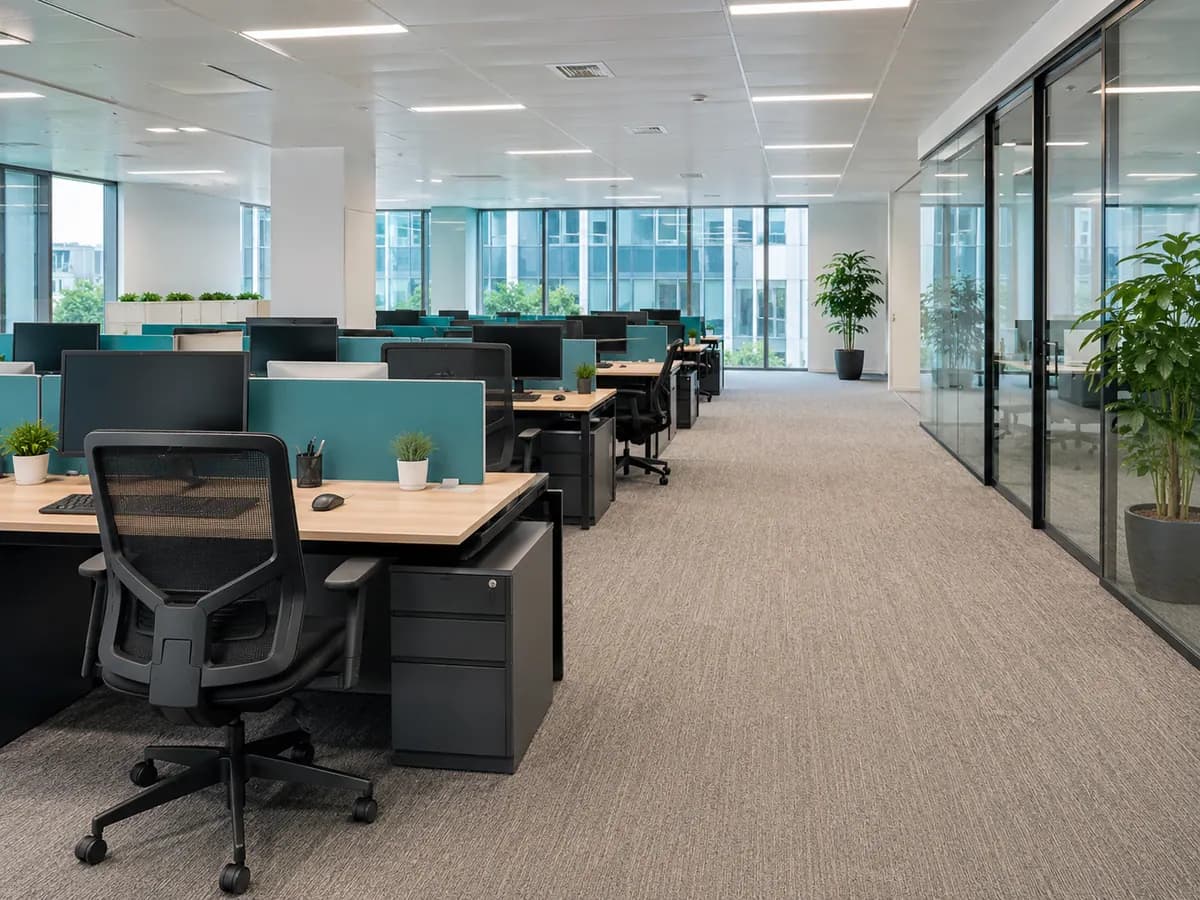
Start with the restroom ratio, not the headcount
The number that predicts complaints better than any other is people per restroom fixture per day.
An office of forty people with six restroom fixtures behaves completely differently from an office of forty people with two. The second one will generate complaints on a three-night schedule that the first one would not generate on a one-night schedule.
The same logic applies to consumables. A restroom serving a lot of people runs out of paper and soap on a timescale set by use, not by the cleaning calendar. If the schedule does not match that timescale, somebody in your office ends up buying paper towels at a supermarket.
So the first question is not "how big is the office" — it is "how many people are using how many restrooms, how many days a week".
Frequency by office profile
What tends to hold, and what tends to slip at each level.
| Office | Usually needs | What slips if you go lower |
|---|---|---|
| Under 10 people, low visitor traffic | Two nights a week | Breakroom and restrooms are visibly behind by day four. |
| 10 to 40 people, shared restrooms | Three to five nights | Restroom consumables run out mid-week and complaints start. |
| Over 40 people | Five nights, sometimes with a day porter | Restrooms become the dominant issue and stay that way. |
| Client-facing suite with a waiting area | Every day you are open | Reception glass and seating look neglected exactly when clients see them. |
| Quiet professional office, few visitors | One or two nights | Rarely a problem, provided restrooms are on every visit that happens. |
| Hybrid office, busy two or three days | Matched to the busy days | Cleaning on quiet nights wastes the visit and misses the actual mess. |
Hybrid working broke the old rule of thumb
The traditional advice was to scale cleaning frequency with headcount. That assumed everyone was in the building every day, which in a lot of offices is no longer true.
A forty-person office where everyone comes in on Tuesday and Wednesday and almost nobody comes in on Friday is not a forty-person office five days a week. It is an eighty-person office twice a week and an empty building the rest of the time.
Cleaning that building on Monday, Wednesday and Friday means one wasted visit, one visit on the wrong night, and a Wednesday that never recovers from Tuesday. Cleaning it on Tuesday and Wednesday evenings does more for less.
If your office has an occupancy pattern, the schedule should have the same shape. Check what your building actually looks like on each day of the week before setting one.
The signal that frequency is wrong
If the same three complaints keep coming up — restrooms, the breakroom, the trash — the answer is almost never a longer scope on the same night. Those are all every-visit items already. Recurring complaints about every-visit items means the interval between visits is too long, not that the visits are too short.
When a day porter makes sense
A day porter is somebody in the building during working hours handling restrooms, common areas and spills as they happen, rather than everything being caught overnight.
It is a different cost structure and it only earns its keep where there is genuine daytime footfall — a building with heavy public traffic, a busy client-facing floor, a site where a restroom serving many people cannot wait until evening.
For most offices it is more than the building needs, and increasing overnight frequency is the better value. The honest test: is anything in your building unacceptable by mid-afternoon? If not, a day porter is solving a problem you do not have.
Office frequency questions
- Can we start low and increase later?
Yes, and it is a sensible way to begin. Start where you think you need to be, live with it for two months, then adjust. Increasing frequency usually improves the per-visit rate as well.
- Is daily cleaning overkill for a small office?
Often, yes — with one exception. If a small office is client-facing, daily is about presentation rather than dirt, and that can be worth it on its own terms.
- What about holidays and shutdowns?
Closures come out of the schedule rather than being billed through. A building that has been closed for a week sometimes wants a heavier first visit back, which is worth planning rather than discovering.
- Should the frequency change seasonally?
It can. Buildings with heavy winter foot traffic need more floor attention; offices that empty out over summer need less. Both are straightforward schedule adjustments.
- How do we know if we are over-cleaning?
Walk the building at the end of a day just before a scheduled visit. If it genuinely still looks acceptable, you have headroom to reduce. Most offices do not, but some genuinely do.
Related reading
Next step
Get your building scoped
Send headcount, restroom count and the days your building is actually busy, and we will propose a frequency that matches.
Book online in a few minutes, or call (972) 440-4421 — texting works too, if that’s easier.